

What a 1 Ton Mini Excavator Really Is
Have you ever scrolled through a few listings and noticed the "1 ton" label on machines that look alike but have different weights on their spec sheets? Before you compare any of them, you need to know what that label actually describes.
What Is a 1 Ton Mini Excavator
A 1 ton mini excavator is a small tracked digging machine whose class name refers to the weight of the machine itself, not to how much it can lift or dig. "1 ton" can mean a short ton (2,000 lb) or a metric tonne (1,000 kg, about 2,205 lb), so confirm which unit the seller means.
The number in the class name describes how heavy the machine is. Lift capacity and dig depth are separate specs, and you'll find them listed elsewhere on the spec sheet.
Short Ton or Metric Tonne
In the U.S., "ton" usually means a short ton of 2,000 lb. Most other countries use the metric tonne of 1,000 kg. The U.S. Energy Information Administration puts one short ton at about 0.907 metric tons. On a 1 ton machine, that works out to a difference of roughly 205 lb. If you're matching the machine to a trailer or planning to drive it across a lawn, you need to know which ton the seller means. A listing that says only "1 ton" doesn't tell you.
Micro, Mini and Compact Excavator Terms
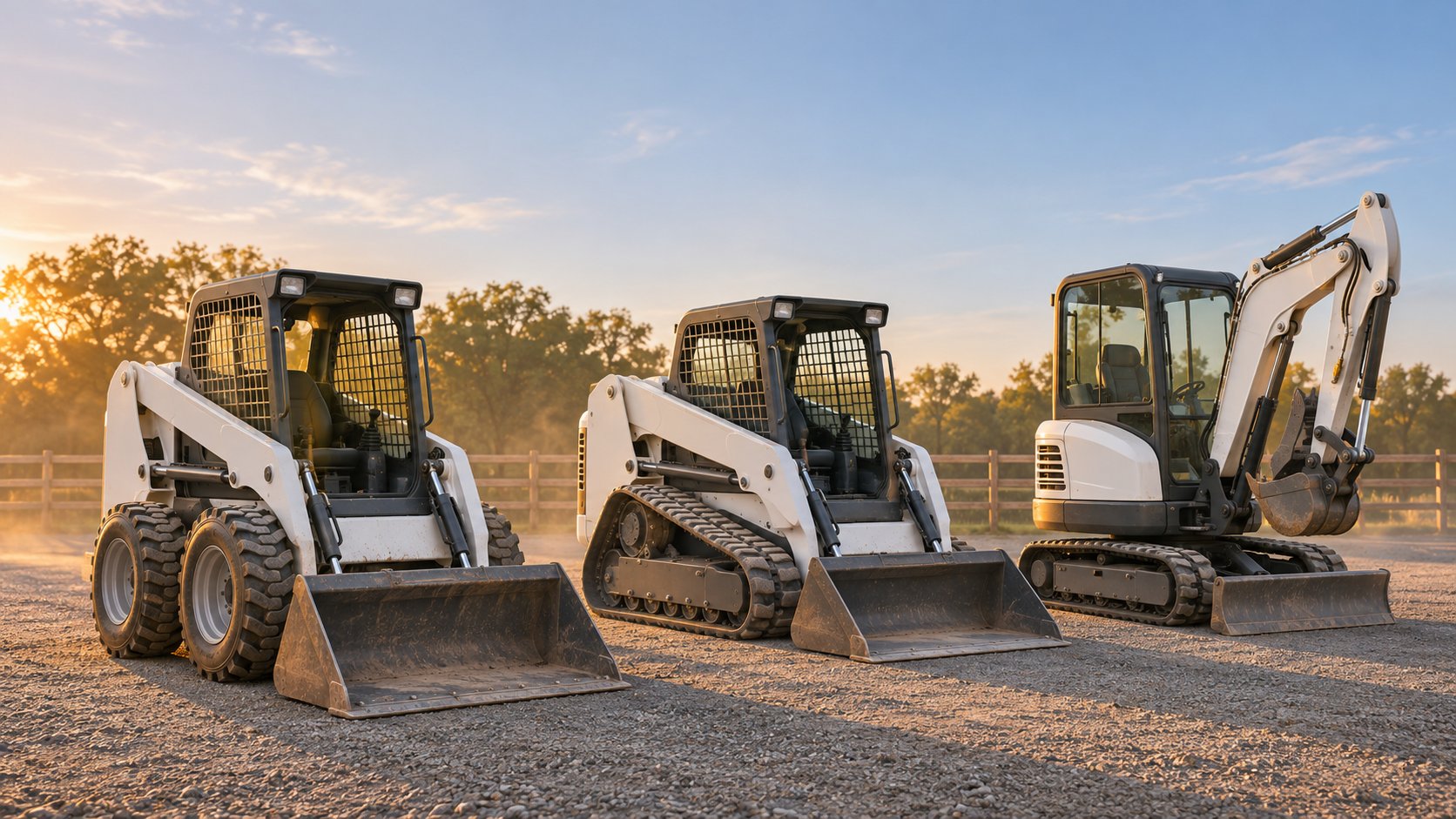
Sellers use micro excavator, mini excavator, compact excavator and small excavator loosely, and the terms overlap. A buyer's guide from SANY says crawler models under 3 tons are often called micro excavators, which places them inside the wider mini class. Bobcat uses compact excavator and mini excavator as the same thing. So a single machine can fairly be sold under three different names.
To keep things clear, this article uses "1 ton mini excavator" for the class and gives actual weights in both lb and kg. These machines usually work on landscaping, trenching for irrigation or utility lines, and tight-access jobs such as backyards behind narrow gates.
Knowing which ton the seller means doesn't settle the question, though. A single spec sheet can list a class weight, an operating weight and a shipping weight, and the three numbers rarely match.
Weight Terms Every Buyer Should Know
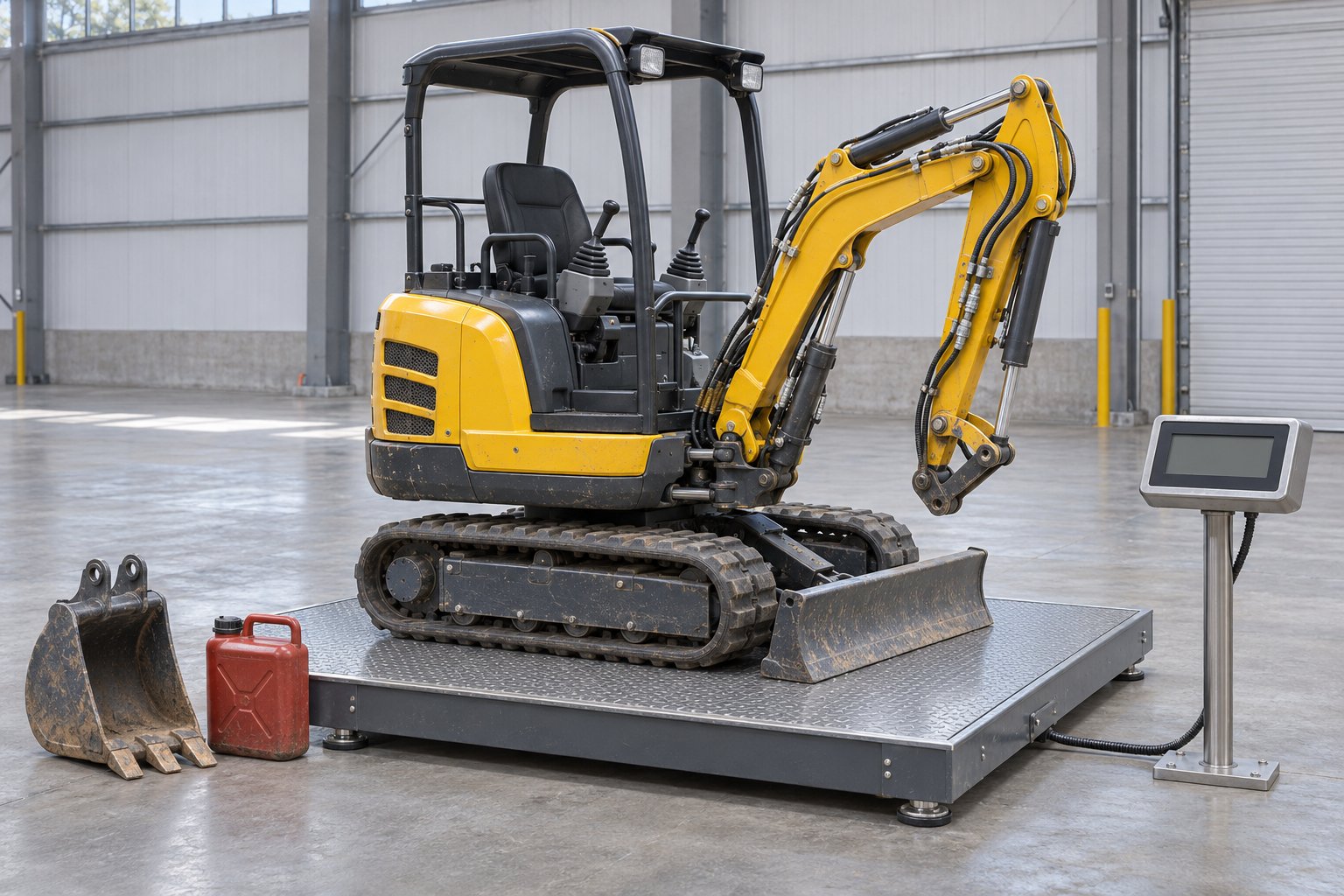
Searching for a mini excavator weight seems like it should return one number. Open a spec sheet for a 1 ton excavator, though, and you'll often find three or four weight figures. Each figure answers a different question. The definitions below are the ones this article uses from here on.
Class Weight Versus Operating Weight
Class weight is the marketing label: the "1 ton" in the product title. It tells you which size bracket the seller has put the machine in. Nobody weighed anything to get it.
Operating weight is the machine ready to work. A dealer guide on excavator weights lists what it covers: the base machine, the front assembly, the counterweight, full fuel and hydraulic tanks, and "usually" the operator. Note the word "usually." Manufacturers don't all define operating weight the same way. One spec sheet may count the bucket and operator, and another may leave them out. Measurement methods for earth-moving machines are covered by ISO 6016, but the standard can't make every listing state its configuration. Check the footnote, or ask the seller what the figure includes.
Shipping Weight and Why It Differs
Shipping weight is the machine as delivered. The same dealer guide says it is usually taken without fuel and sometimes without the bucket. On online listings, a shipping weight may also include a crate or attachments packed with the machine. Depending on what's in the box, it can come out above or below the operating weight. Freight carriers bill on this figure. Don't use it to size your trailer, because the machine gets heavier once it's fueled and has a bucket fitted.
Lift Capacity Is a Separate Number
Lift capacity is how much the machine can safely raise at a given reach and position. It drops as the load moves farther from the machine, and a heavier attachment reduces it further. You'll find it on the lift chart. The class name doesn't tell you a 1 ton micro excavator can lift one ton.
| Term | What It Measures | Where It Appears on a Listing | Why It Matters |
|---|---|---|---|
| Class weight | The size bracket the seller assigns | Product title, category or collection name | Gives you a starting point for search but isn't a measurement |
| Operating weight | The machine ready to work, including whatever the spec sheet says: fluids, bucket, operator | Spec sheet or specifications tab | The figure to use when comparing machines and planning transport |
| Shipping weight | The machine as delivered, sometimes with a crate or attachments | Shipping details or freight quote | Sets the freight cost but can understate the working load |
| Lift capacity | Safe load at a specific reach and position | Lift chart or operator's manual | Changes with radius and has nothing to do with the class number |
Quick conversions:
- 1 short ton = 2,000 lb, about 907 kg
- 1 metric tonne = 1,000 kg, about 2,205 lb
Amazon listings for the MS10H, for example, give about 1,000 kg / 2,205 lb, which matches the metric tonne. In that case the class label and the listed weight agree. Many listings don't line up this well, and some put machines that weigh much more than either kind of ton into the 1 ton category.
Why the 1 Ton Label Is Used Inconsistently
Try searching for a mini excavator 1 ton and filtering by that category. You'd expect every result to weigh about 2,000 lb or 2,205 lb. Within a minute of scrolling, you'll find machines that weigh well over both figures. Each seller stretches the label in its own way.
How Retailers Group the 1 Ton Class
These examples come from seller pages and marketplace search results:
- HUAYEE sells the HY14C as a 1.4-ton model and lists it in its 1-ton collection.
- Amazon search results for 1-ton machines also include the 1.2-ton MS12P and the 1.5-ton MS15P. The MS15P is listed at 3,307 lb, which matches 1,500 kg.
- AGT groups 1 to 2 ton machines together. If you browse that category for an agt industrial mini excavator, you may see models listed at up to twice the class number.
- TYPHON is a Singapore-based manufacturer that sells direct to consumers online. It gives a weight range for this class that reaches 2,700 lb.
Unclear units add to the problem. If the seller means short tons, a 1.4-ton HY14C weighs 2,800 lb. If the seller means metric tonnes, it weighs about 3,086 lb. Under either unit, the number alone doesn't make it a 1-ton mini excavator.
Why Some 1 Ton Machines Weigh 2,700 lb
2,700 lb is about 1,225 kg. That is 700 lb more than a short ton and roughly 495 lb more than a metric tonne. Sellers rarely explain the gap. These are possible reasons:
- The operating weight may include a cab, full fluids or attachments that a bare machine wouldn't carry.
- The seller may use "1 ton" as a broad marketing bucket for its smallest machines, without meaning it as a weight.
- The listing may not state the unit, so you can't tell which ton is meant or whether a figure is in kg or lb.
A single listing could involve any of these, or several at once. You won't know which one applies until the seller tells you, so don't rely on the number in the title alone.
Treat "1 ton" as a starting point, then confirm the operating weight in kg or lb on the spec sheet before you compare, haul or buy.
Questions That Pin Down the Real Weight
A short message to the seller usually settles it. Ask these questions:
- Which ton do you mean: a short ton (2,000 lb) or a metric tonne (1,000 kg)?
- What is the operating weight in kg or lb, and what does it include? Fuel, hydraulic oil, bucket, operator, cab?
- What is the shipping weight with the attachments that come with the machine?
If the seller answers all three in writing, you have numbers you can compare. Much of the confusion starts in the product title, though. The same title often includes engine codes, horsepower ratings and feature tags, and each of those needs the same checking.
How to Read a 1 Ton Excavator Listing
Search for a 1 ton mini excavator for sale and most product titles look like a string of codes: a weight, an engine name, a horsepower figure, a displacement in cc and a few feature tags. Each fragment means something, but a title has no room to explain it. You'll get more out of a listing if you know what each fragment tells you and what it leaves unsaid.
Decoding a Mini Excavator Sale Listing
The table below covers the fragments you'll see most often in marketplace titles.
| Listing Fragment | What It Means | Why It Matters | What to Ask the Seller |
|---|---|---|---|
| Operating weight | The machine ready to work, in whatever setup the seller weighed it | Sets your trailer, tow vehicle and ground limits | Is it in kg or lb, and does it include fuel, bucket, operator and cab? |
| Engine model | The engine brand and model code | Decides the fuel type, where parts come from and what emissions paperwork exists | What is the exact engine model and fuel type, and is it certified for U.S. sale? |
| HP | The engine's power rating | Drives the hydraulic pump but doesn't measure digging performance on its own | Is it gross or net horsepower, and what are the hydraulic flow and pressure? |
| Displacement | Engine size, usually in cc | Lets you check that the engine is the one the title names | Does this figure match the engine maker's published spec? |
| Hydraulic thumb | A clamp opposite the bucket for gripping rocks, logs and debris | Needs a hydraulic circuit and adds weight at the end of the arm | Is it included, and is it hydraulic or a fixed mechanical thumb? |
| Coupler | The connection between the arm and the attachment | Affects how quickly you can swap attachments and whether they fit | Is it a quick coupler or pin-on, and what are the pin diameter and pin spacing? |
| Enclosed cab | A closed operator station in place of an open canopy | Adds weight and height, which affects hauling and overhead clearance | Are the listed weight and height for the cab version or the canopy version? |
The coupler row needs extra care because excavator attachments are not universal. Pin diameter, pin center distance and coupler standard vary between brands and sometimes between models from the same brand. The S-40 coupler standard is sized for machines of 1 to 4 tons. Changing a pin-on attachment by hand takes 8 to 12 minutes. A coupler tag in the title tells you a coupler is fitted. It doesn't tell you which standard it follows.
The cab row matters for a similar reason. Most mini excavator lines come in canopy or cab versions, and the cab's extra weight and height come up again when you check your site and your trailer.
Specs That Matter Most
Feature tags catch the eye. A micro excavator for sale with a thumb, coupler and cab in its title can look better equipped than a plainer listing, but those extras matter least when you compare machines. Rank the fragments in this order instead:
- Operating weight and unit. Every decision about hauling the machine and fitting it on your site depends on this number.
- Dig depth. If the machine can't reach the depth your trench needs, the other specs don't matter.
- Overall width. This decides whether the machine fits through your gate.
- Engine and fuel type. These affect refueling, servicing and paperwork.
- Convenience features. A thumb, coupler or cab is worth paying for only on a machine that already passes the first four checks.
What Listings Often Leave Out
Some of the most useful details rarely appear in a title:
- Maximum dig depth. Many titles leave it out. Find it on the spec sheet or ask for it.
- Warranty terms. Some sellers advertise a 1-year warranty. Ask what it covers, whether it includes both parts and labor, and what would void it.
- EPA or CARB certification. For any new mini excavator for sale in the U.S., ask for the engine's EPA Certificate of Conformity. The engine manufacturer holds this certificate, not the machine brand. A CE mark does not count as EPA compliance, and California's CARB rules are stricter than the federal ones.
- Parts availability. Ask where filters, tracks and hydraulic parts ship from and how long they take to arrive.
Engine details cause the most confusion. Two listings can show the same horsepower with different engine brands, and the brand alone won't tell you whether the machine runs on gas or diesel.
Engines and Power Sources in the 1 Ton Class
When two listings show the same horsepower, the engine name is often the only thing in the title that tells them apart. That name tells you who built the engine. It doesn't always tell you what fuel the engine burns.
RATO, Briggs and Stratton, Kohler and Kubota Engines
RATO, Briggs & Stratton, Kohler and Kubota are the engine brands you'll see most often in this class. Some engine makers build both gas and diesel models, so check the fuel type on each listing instead of guessing it from the brand. Read the wording closely as well. A title for a "mini kubota excavator" might describe a machine Kubota built, or it might describe an import that only uses a Kubota engine. Those are different purchases, and the dealer support behind them is different too.
Gas Versus Diesel Mini Excavator Trade-Offs
One dealer comparison says a diesel mini excavator usually suits long work sessions and steady hydraulic demand, while gas suits occasional property jobs. The trade-offs break down like this:
Diesel Pros and Cons
- Pro: A gallon of diesel holds more energy than a gallon of gasoline, according to U.S. Department of Energy data. Actual fuel use still depends on the machine and the job.
- Pro: If you already run diesel trucks or tractors, the excavator can share their fuel storage and service routine.
- Con: Diesel can thicken or gel in the cold. Cold starts depend on the glow plugs, the battery and winter-grade fuel.
- Con: Stored diesel has to be kept free of water, contamination and microbial growth.
Gas Pros and Cons
- Pro: Almost every fuel station sells gasoline, so a weekend job doesn't require fuel storage on site.
- Pro: If you already look after small gas engines, you'll know the routine tasks, such as checking spark plugs and servicing the air filter.
- Con: Gasoline breaks down in storage and can leave deposits in the fuel system. This is a real issue for a machine that sits unused between projects.
- Con: Old fuel, a weak battery or using the choke wrong can make cold starts hard.
Two checks apply to either fuel. Parts and service access depend on the exact engine model and on repair shops near you. Emissions certification belongs to the engine, so ask for its EPA certificate whether it runs on gas or diesel.
What a 13.5 HP Rating Tells You
Listings in this class often show a 13.5 HP rating. One seller's guide lists 13.5 HP machines with operating weights from 1,940 to 2,227 lb, so machines with the same rating can differ by almost 300 lb. The engine drives the hydraulic pump, and the hydraulics do the digging. Hydraulic flow mostly sets how fast the boom and arm move. Pressure and the machine's mechanical design set how much force they deliver. Dig depth and machine weight decide how deep you can dig and how steady the machine stays. Because of all this, horsepower alone can't rank two machines.
Checking Electric Claims
A letter in a model name, such as an "E" suffix, doesn't prove the machine runs on a battery. Confirm battery or electric drive on the manufacturer's spec sheet, and look for the battery and charger details there. If you need electric power for one indoor or noise-sensitive job, ask local yards about electric mini excavator rental. Some fleets may carry electric units.
The power source decides how the machine runs. Whether it can get to the work at all depends on its width, height and dig depth, measured against your site.
Will It Fit Your Site and Your Job
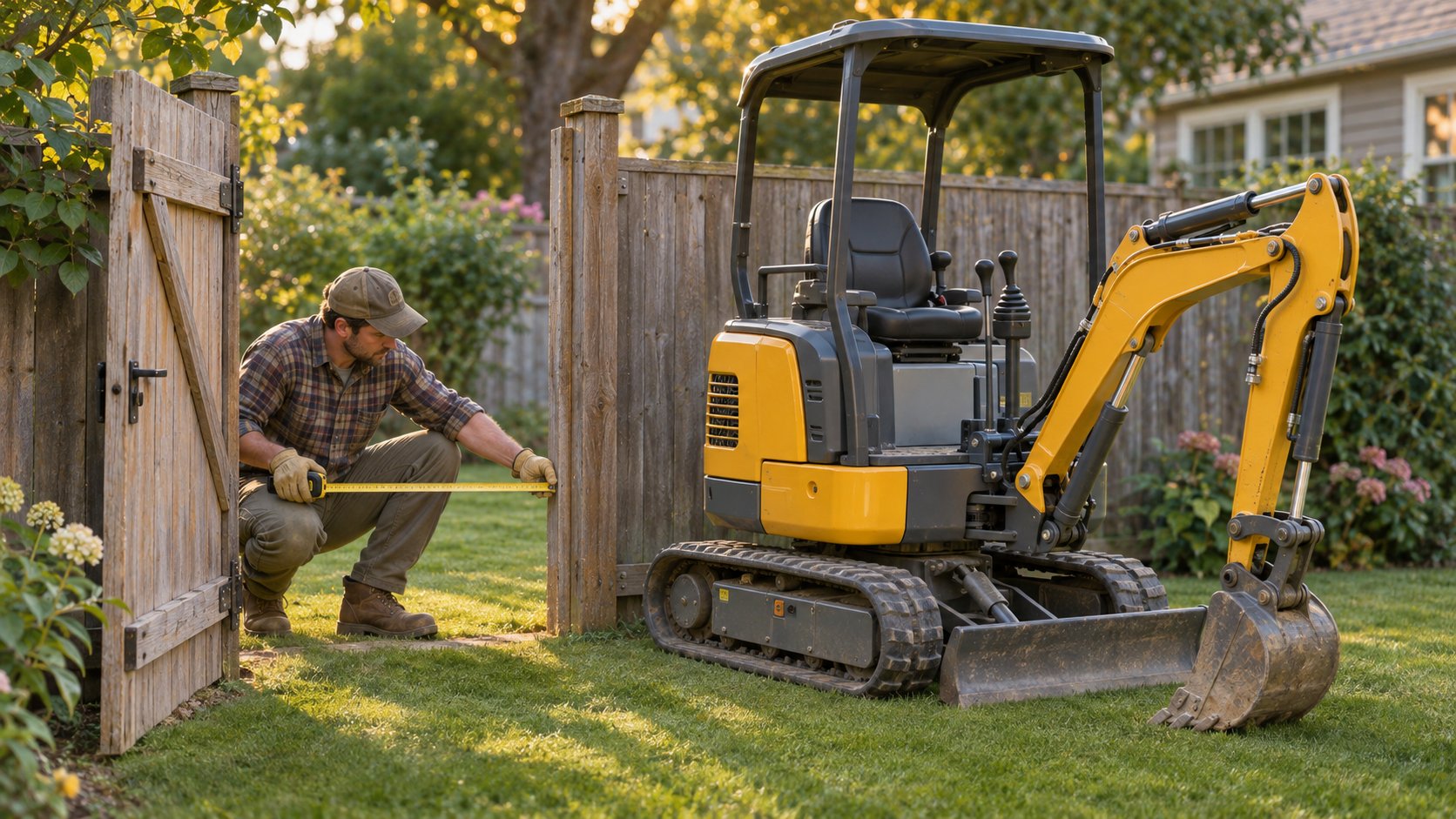
Imagine the delivery truck pulls up and the machine won't fit through your side gate. A small excavator is only useful if it can get to the work, clear whatever is overhead and dig as deep as the job needs. Measure your site first. Then compare each measurement with the matching figure on the spec sheet.
Gate Width and Track Width
Find the narrowest point on the route in, such as gate posts, a doorway or the gap between a house and a fence. Compare it with the machine's overall width as well as its track width, because the two figures can differ. Some models have retractable undercarriages that pull the tracks in for access and push them out for work. Kubota's U10-5, built for the 0 to 1 ton range, has an adjustable track gauge, for example. If you're counting on a compact mini excavator that narrows, confirm on the spec sheet that the model really has this feature and check whether the listed width is the retracted or the expanded figure.
Overhead Clearance and Canopy Height
Look up along the route and above the dig area. Note door headers, carports, tree limbs and power lines. Compare the lowest one with the canopy or cab height. An enclosed cab changes the height, so make sure the figure you're reading is for the version you'd actually get. The boom also rises when the machine digs and dumps, so check the space above the work area too, not just the route in.
Dig Depth Versus the Job
Get the depth your trench needs from your plans, the utility company or local code. Then compare it with the listed maximum dig depth. That maximum is the deepest point the bucket can reach, so leave some margin. Bobcat's buyer's guide notes that smaller, lighter excavators may dig shallower than heavier machines.
Ground, Slopes and Stability
Low weight helps a tiny excavator fit through tight spaces, and the same guide says compact machines put less pressure on the ground, which reduces surface damage. That low weight works against you when the arm reaches out or lifts. Lift capacity depends on the center of gravity, the lift geometry and the counterweight. A light machine carries little counterweight to balance a load held far from its tracks, so it tips sooner. If the tracks retract, widen them before you start work. A JCB product manager names working with the tracks retracted as a common mistake that compromises the center of gravity. On slopes, stay within the limits in the operator's manual.
| Site Constraint | Spec to Check | Where to Find It | Common Pitfall |
|---|---|---|---|
| Gate or doorway width | Overall width and track width, retracted if adjustable | Spec sheet dimensions | Checking only track width, or assuming every model retracts |
| Overhead clearance | Canopy or cab height | Spec sheet dimension drawing | Reading the canopy height for a cab version |
| Required trench depth | Maximum dig depth | Spec sheet working range | Treating the maximum as an everyday working depth |
| Lawn or finished surfaces | Track type (rubber or steel) and ground pressure | Spec sheet or listing | Spinning in place on turf or pavers and tearing the surface |
| Slopes | Operating weight, expanded track width, slope limits | Spec sheet and operator's manual | Working on a slope with the tracks retracted |
Measure these before you contact a seller or rental yard:
- The narrowest width along the access route
- The lowest overhead obstacle on the route and above the dig area
- The trench or hole depth the job requires
- The surface type the machine will cross
- The steepest slope it will work on
These five measurements cover the site itself. Before any of them matter, the machine has to travel to your site, and its weight and height then have to suit a trailer and tow vehicle.
Hauling a 1 Ton Machine Safely
A machine this small looks like it would ride on almost any trailer. But have you added up everything you'd actually be pulling? Cojo Excavation and Asphalt, an Oregon contractor, says towing is where many DIY rentals go wrong. People match the trailer to the truck's hitch and skip the math behind it.
Towing a 1 Ton Mini Digger
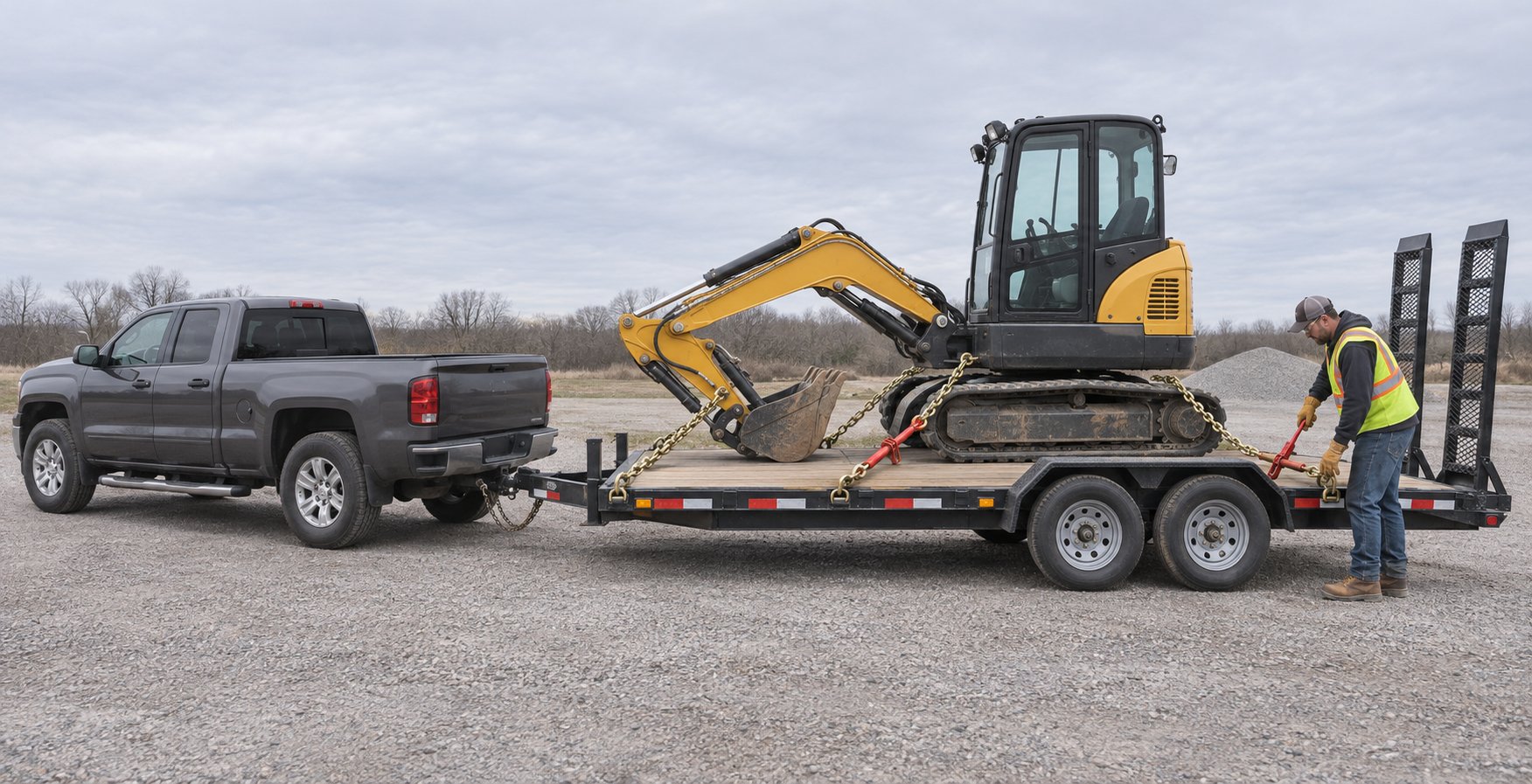
The class number in the listing is not the weight you'll tow. The real load is the operating weight, plus any attachments, plus a full fuel tank, plus the trailer's own empty weight. The weight terms from earlier in this article matter here. A cab version weighs more than a canopy version, and every extra bucket or thumb you carry raises the total. Shipping weight is often measured without fuel or a bucket, so it understates the load.
Trailer and Tow Vehicle Limits to Check
Several ratings have to line up, and the lowest one sets your limit. Cojo puts it plainly: a truck that can "tow 10,000 pounds" doesn't help if the trailer or hitch is rated lower. Run this check before each trip:
- Total the load. Start from the operating weight, or from the shipping weight plus fuel and bucket, and add every attachment you'll carry.
- Compare it with the trailer. The machine load must stay under the trailer's payload rating. The machine plus the trailer's empty weight must stay under its GVWR.
- Check the tow vehicle and hitch. The truck's towing capacity and the hitch and ball ratings must each exceed the weight of the loaded trailer.
- Confirm transport dimensions. Get the length, width and height with the boom folded from the spec sheet.
- Check the ramps. The ramp rating must cover the machine, and the ramp angle must fall within what the operator's manual allows for a tracked machine.
- Find the tie-down points. Use the tie-down points the manufacturer marks on the machine and rated anchor points on the trailer.
Weight is only one part of the legal side. Bobcat notes that load ratings vary by state. It advises checking federal, state and local rules on weight, width, length and height before you haul. Trailer brake, licensing and permit requirements depend on where you drive, so check your own state's rules along with the trailer and vehicle manufacturers' ratings.
Loading, Tie-Down and Delivery Options
Loading a tracked machine onto a trailer is routine for professionals, but most renters have never done it, and wet ramps make it riskier. If you don't own a truck and trailer clearly rated for the load, Cojo says delivery is usually the better choice. A mini excavator rental with delivery takes the weight math and the loading risk off your hands. Some dealers, such as Wheeler Machinery, list pickup and delivery among their rental services. Buying online works differently because the machine usually arrives by freight. Whether you're renting a mini excavator, booking a micro excavator rental or ordering one shipped, ask these questions:
- Can the delivery truck reach the site, turn around and unload on level ground?
- Will the driver unload the machine, or do you need to arrange that yourself?
- Does the machine have to cross a lawn, curb or driveway to reach the work area?
- Is delivery and pickup priced separately from the machine?
The answers often depend on who sold you the machine. A dealer rental may come with a driver who knows the model. An online purchase may arrive on a freight truck with only the seller's spec sheet to go on, and how much you can trust that sheet depends on the brand behind it.
Name Brands Versus Budget Imports
Why would two machines of about the same size sell for very different prices? A few of the reasons show up on the spec sheet. Most of them don't. The table in this section puts established brands and budget imports side by side, using published figures where they exist. Where a figure wasn't available in the sources reviewed for this article, the cell says Check spec sheet.
Established Brand Models in the Micro Class
Kubota, Yanmar, Bobcat and Takeuchi each sell a micro-class machine through dealers. Yanmar's SV08-1C spec sheet shows the level of detail you can expect from an established brand. It lists an operating mass of 1,035 kg (2,282 lb) and a machine mass without implement of 675 kg (1,488 lb). One machine can therefore carry two published weights that differ by 360 kg (794 lb), which is why you need to know which weight a listing quotes. The engine is a two-cylinder, water-cooled diesel rated 7.7 kW (10.3 hp). The lift chart follows ISO 10567 and marks which ratings are limited by the hydraulics and which by tipping.
Budget Import Models Sold Online
Imported machines, which often turn up in marketplace searches for a chinese mini excavator, are sold through online stores, marketplaces and equipment retailers. The model names cause confusion. A search for an agt mini excavator h15r will probably return two different machines. Chupp Industrial has sold both, and it says the CFG H15R and the AGT H15 share a 13.5 HP RATO R420D gas engine and a 65 in dig depth but are not the same machine. The AGT H15 weighs about 115 lb more and comes with a hydraulic thumb and a canopy. The lighter cfg industrial mini excavator in that lineup, the KT13R, weighs 1,785 lb.
Spec figures for the HUAYEE HY10C and HY14C and for the Amazon MS10H didn't appear in the published sheets reviewed here. The same goes for anyone shopping for the agt mini excavator agt-h12. Ask the seller for a complete spec sheet before you compare any of these machines. The Yanmar's 10.3 hp diesel is rated below the 13.5 HP gas engines on the imports, which shows again that horsepower alone can't rank machines.
| Model | Operating Weight | Max Dig Depth | Overall Width | Power Source and Engine | Sales Channel |
|---|---|---|---|---|---|
| Kubota K008-5 | Check spec sheet | Check spec sheet | Check spec sheet | Check spec sheet | Authorized dealers |
| Yanmar SV08-1C | 1,035 kg (2,282 lb) | Check spec sheet | Check spec sheet (variable track gauge, blade 680/840 mm) | Diesel, Yanmar 402J-05, 7.7 kW (10.3 hp) | Authorized dealers |
| Bobcat E10e | Check spec sheet | Check spec sheet | Check spec sheet | Check spec sheet | Authorized dealers |
| Takeuchi TB210R | Check spec sheet | Check spec sheet | Check spec sheet | Check spec sheet | Authorized dealers |
| HUAYEE HY10C | Check spec sheet | Check spec sheet | Check spec sheet | Check spec sheet | HUAYEE online store |
| HUAYEE HY14C | Sold as 1.4-ton; check spec sheet | Check spec sheet | Check spec sheet | Check spec sheet | HUAYEE online store |
| AGT H12 | Check spec sheet | Check spec sheet | Check spec sheet | Check spec sheet | Online sellers |
| AGT H15 | 2,315 lb (1,050 kg) | 65 in | 39.37 in | Gas, RATO R420D, 13.5 HP | Retailers such as Chupp Industrial |
| CFG H15R | 2,200 lb (about 998 kg) | 65 in | 40 in | Gas, RATO R420D 420 cc, 13.5 HP | Retailers such as Chupp Industrial |
| CFG Industrial KT13R | 1,785 lb (about 810 kg) | Check spec sheet | Check spec sheet | Gas, RATO 420 cc, about 13.5 HP | Retailers such as Chupp Industrial |
| MS10H | Listed at about 1,000 kg (2,205 lb); confirm it is the operating weight | Check spec sheet | Check spec sheet | Check spec sheet | Amazon |
Where Price Differences Usually Come From
When you compare a dealer machine with an online import, you'll notice the biggest differences are in the support behind the machine:
- Dealer and parts support. Established brands usually sell through dealers who stock parts and service the machines. With an online import, parts may have to ship from the seller, so ask where they come from and how long they take to arrive.
- Warranty terms. Ask what each warranty covers, who does the repair work, and whether you have to ship the machine or the failed part back.
- Emissions certification. Whatever the brand, ask for the engine's EPA certificate, and for CARB documentation if you work in California.
- Resale. Machines with familiar names and dealer service records usually find used buyers more easily, though that isn't guaranteed.
- Build documentation. Look for a spec sheet that states what the operating weight includes, a lift chart that names its standard, and a clear operator's manual. The SV08-1C sheet is a good example of all three.
The sticker price doesn't include any of these factors, but each one changes what the machine costs you over the years you own it. Whether that cost makes sense also depends on how many days a year you'd actually use the machine.
What Renting or Buying One Costs
Will you use the machine for one weekend, or on every job this year? Your answer changes which costs count. The figures below come from published guides. Treat them as rough numbers and confirm them with local yards and sellers.
How Much Does It Cost to Rent a Mini Excavator
A 2026 rental guide from an attachment retailer puts the 1 to 2 ton class at about $200 to $250 per day. The guide says weekly rates usually run three to four times the daily rate. Monthly rates come to around ten to twelve times the daily rate. The day rate is only part of the bill, and these items change the total:
- Rental period. Daily rentals cost the most per day, so a job that lasts several days may be cheaper on a weekly rate.
- Delivery and pickup. The same guide puts these at $100 to $300 round trip, billed separately.
- Attachments. Augers, breakers, thumbs and grapples cost roughly $40 to $150 a day each.
- Damage waiver. This usually runs about 10 to 15% of the rental rate if your insurance doesn't cover rented equipment.
- Fuel. Most yards expect the machine back with a full tank, or they add a charge.
- Cleaning fees. A machine returned dirty may carry a surcharge.
That quoted rate covers a 1 to 2 ton bracket, and a machine at the top of that bracket can weigh about twice as much as one at the bottom. When you search for a mini excavator rental near you, ask for the actual operating weight of the unit you'll get. Rental yards may group machines by class as loosely as retailers do.
How Much Does a Mini Excavator Cost to Buy
A cost comparison from a company that sources Chinese machines puts a new 1-ton machine at $9,800 to $35,000. In that comparison, landed imports cost $9,800 to $15,000 and premium dealer brands cost $25,000 to $35,000. Where a particular machine falls in that range depends on these factors:
- Engine brand. The same source says the cheapest option is usually an import with a domestic Chinese engine.
- Features. A thumb, quick coupler or enclosed cab each add to the price.
- Freight and import charges. The landed price includes shipping, tariffs and inland freight, so compare landed prices with each other, not with factory prices.
- Warranty coverage. Parts-only coverage costs the seller less to offer than parts and labor.
- Certification. EPA or CARB paperwork should be included in the price you pay. You shouldn't have to chase it after the sale.
Renting Versus Buying a 1 Ton Machine
A Northeast dealer's rent-versus-own breakdown offers a rough threshold. If a machine will work fewer than 400 to 500 hours a year, or fewer than 12 to 15 weeks, renting usually costs less. That guide looks at 3 to 6 ton machines, so use it only as a starting point for this smaller class.
| Factor | Renting | Buying |
|---|---|---|
| Frequency of use | Suits one-off or occasional jobs | Suits regular, predictable work |
| Storage | The yard stores the machine | You need secure space between jobs |
| Maintenance responsibility | Mostly the yard's | Yours, including finding parts |
| Transport ownership | Delivery is available for a fee | You need a rated truck and trailer, or you pay a hauler each time |
| Resale | None, and you build no equity | You recover part of the price when you sell |
A low rate saves money only if the machine can actually do the work. If your trench is deeper or your loads are heavier than this class can handle, a larger machine may cost less overall.
Choosing Your Class and Sourcing the Right Machine
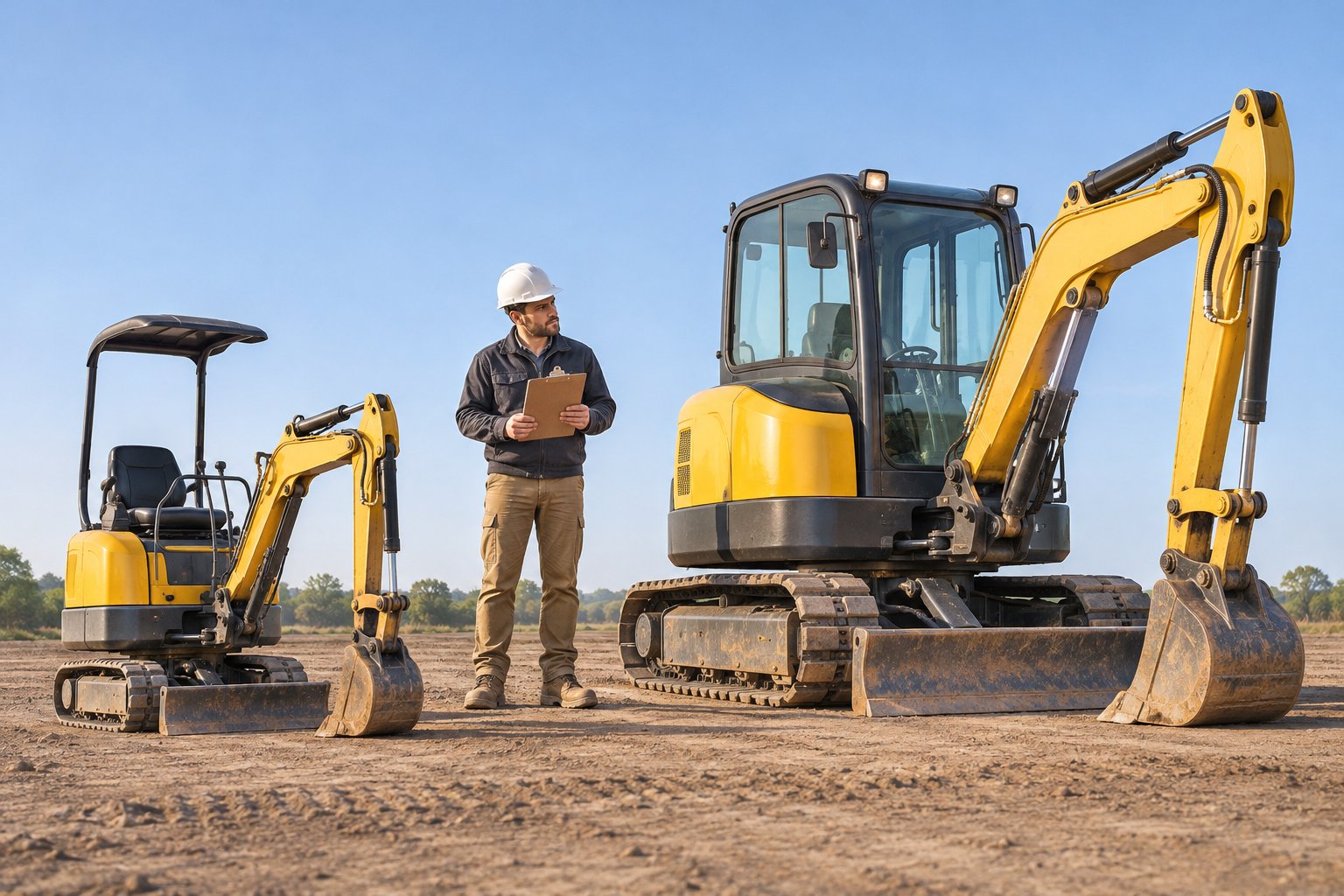
How can you tell when a job has outgrown the 1 ton class? Go through the checks below before you buy a mini excavator from any seller. You can answer them with the measurements you've already taken.
Signs You Need a Bigger Class
- Dig depth and reach. If the trench depth on your plans is close to the listed maximum, move up a class. Do the same if the spoil has to land farther away than the arm can reach. Southeastern Equipment gives dig depths of 8 to 14 feet for mini excavators of 1 to 6 tons. The AGT H15 and CFG H15R from the earlier comparison table both list 65 in, so don't assume the lightest machines reach the low end of that range.
- Lifting or stability. Will you lift pipe, stone or stumps at full reach, or work on slopes? A heavier machine carries more counterweight and stays steadier. Base the decision on the lift chart, not the class number.
- Cab requirement. If you need an enclosed cab for weather or year-round work, confirm that the model offers one. Remember that a cab adds weight and height.
- Attachment size. Breakers, augers and wide grading buckets need a matching coupler, enough hydraulic flow and enough machine weight. If the maker lists an attachment only for heavier machines, a 1 ton machine won't run it well.
A bigger machine brings its own costs. It is usually wider, heavier and taller, so it may not fit through your gate, and it may need a bigger trailer and tow vehicle. Moving toward a 4 ton mini excavator means running the site and hauling checks again with the new numbers. The same applies when you compare two models from one lineup, such as HUAYEE's HY10C and HY14C. Ask the seller what the heavier model adds, and confirm the answer on both spec sheets.
Mini Excavator or Mini Backhoe
Some listings call a small excavator a mini back hoe. The two names get mixed up because both machines dig with an arm that pulls earth toward the operator. They are different machines, though. A backhoe is built on a tractor, with a loader on the front and a digging arm on the back, and its digging arm swings through only 180 degrees. An excavator has no loader, and its upper structure turns a full 360 degrees. A backhoe-style bucket on a mini excavator doesn't mean the machine can load trucks or carry material the way a loader does. If you need loading, tell the seller that directly.
Your Spec Checklist Before You Buy a Mini Excavator
- Which ton you mean, short (2,000 lb) or metric (1,000 kg), and your target weight in kg or lb
- The operating weight range you can accept, and what that weight must include
- The dig depth and reach the job needs
- The width limit set by your narrowest access point
- The power source: gas, diesel or electric drive confirmed on the spec sheet
- The attachments you need and the coupler type
- Certification: an EPA certificate, plus CARB documentation if you work in California
- The delivery location and when you need the machine
Send the finished checklist to every seller you're considering, whether you're browsing 1 ton diggers for sale online or talking to a local dealer. Contractors and importers with specific requirements can also send it through JIUHONG's inquiry page. If you need a specific operating weight, reach or power source, list those details and ask the sales team whether they can supply an exact match. A machine from a nearby weight class is not an exact match. Whoever the seller is, get the offered model's weight, power source and capabilities confirmed in writing before you pay.
1 Ton Mini Excavator FAQs
1. How much does a 1 ton mini excavator weigh?
The weight depends on which ton the seller means and which weight figure you are reading. A short ton is 2,000 lb (about 907 kg). A metric tonne is 1,000 kg (about 2,205 lb), so the two meanings differ by roughly 205 lb. Many listings stretch the label further. Some retailers file 1.2-ton, 1.4-ton and 1.5-ton models in the same 1-ton category, and one seller's range for the class reaches 2,700 lb. Ask the seller for the operating weight in kg or lb and what it includes, such as fuel, hydraulic oil, bucket, operator and cab. Keep shipping weight separate. It is often measured without fuel or a bucket and may include a crate, so it rarely matches the working weight.
2. Can a 1 ton mini excavator lift 1 ton?
Don't assume it can. The 1 ton figure describes how heavy the machine is, not how much it can raise. Safe lift capacity comes from the lift chart, and it falls as the load moves farther from the tracks or as you fit a heavier attachment. A light machine carries little counterweight, so it reaches its tipping limit sooner at full reach. Use a lift chart that names its standard. For example, Yanmar's SV08-1C chart follows ISO 10567 and marks which ratings are limited by the hydraulics and which by tipping. Work with retractable tracks fully expanded. If you often lift pipe, stone or stumps at a distance, consider moving up a class.
3. How deep can a 1 ton mini excavator dig?
Dig depth varies by model, and product titles often leave it out, so get it from the spec sheet. As a reference point, the AGT H15 and CFG H15R both list 65 in. Dealer figures of 8 to 14 ft cover mini excavators from 1 to 6 tons, and the lightest machines fall well short of the top of that range. The listed maximum is the deepest point the bucket can reach. It is not a comfortable everyday working depth. Get the depth your trench needs from your plans, the utility company or local code, and leave some margin. If the job is close to a machine's maximum, look at a larger class.
4. How much does it cost to rent or buy a 1 ton mini excavator?
One 2026 rental guide quotes about $200 to $250 a day for the 1 to 2 ton class, with weekly rates around three to four times the day rate. The same guide lists these extra costs: delivery and pickup at $100 to $300 round trip, attachments at $40 to $150 a day each, and a damage waiver of roughly 10 to 15%. Fuel and cleaning charges may also apply. For a new machine, one sourcing company's comparison puts landed imports at $9,800 to $15,000 and premium dealer brands at $25,000 to $35,000. Engine brand, a thumb, coupler or cab, freight, warranty and EPA or CARB paperwork all affect where a machine falls in that range. Renting usually makes more sense for occasional jobs. If you are buying to a set spec, send the operating weight, reach, power source and delivery details to each seller you're considering, such as through JIUHONG's inquiry page, and ask whether they can supply an exact match. A nearby weight class is not an exact match, so get the offered model's specs confirmed in writing before you pay.
5. What do I need to tow a 1 ton mini excavator?
Start with the real load: the operating weight plus fuel and every attachment you will carry. The machine must stay under the trailer's payload rating. The machine plus the empty trailer must stay under the trailer's GVWR. The truck's towing capacity and the hitch and ball ratings must each exceed the loaded trailer weight. The lowest rating in that chain sets your limit. Also confirm the transport length, width and height with the boom folded, the ramp rating and angle, and the tie-down points the manufacturer marks on the machine. Trailer brake, licensing and permit rules vary by state, so check your local requirements. If you don't own a truck and trailer rated for the load, a rental with delivery is often simpler and safer.