

The Short Answer on Bobcats and Skid Steers
Picture a contractor asking you to "grab the Bobcat" from the yard. You could walk out and find a wheeled loader, a tracked loader or a small excavator, all with the same logo on the side. So is a Bobcat a skid steer? Sometimes. It depends on which Bobcat machine you mean.
Bobcat is an equipment brand: Bobcat Company, part of Doosan Bobcat. A skid-steer loader is a type of compact machine. Bobcat builds skid steers, but so do many other manufacturers, and Bobcat also sells machines that are not skid steers. Some Bobcats are skid steers, and many skid steers are not Bobcats.
Bobcat Is a Brand and Skid Steer Is a Machine Type
Bobcat is the name of a company. Bobcat Company is a member of the Doosan Group. A skid steer, or skid-steer loader, is a category of machine. Its design and the way it turns define it, and any manufacturer can build one.
That is why searches like "bobcat vs skid steer" or "skid steer vs bobcat" compare two different kinds of things. Think of asking about Ford vs pickup trucks. Ford makes pickups, but it also makes vans and SUVs, and plenty of other companies make pickups too.
Bobcat's lineup works the same way. Its equipment catalog includes skid-steer loaders, compact track loaders and compact excavators, along with mowers, tractors and forklifts. When you hear a machine called "a Bobcat," you learn who built it. You don't learn what kind of machine it is.
The Answer Works in Both Directions
Turn the question around and the answer is no. Not every skid steer is a Bobcat. Bobcat is one of several companies that build skid-steer loaders, and a later section names the other major makers. A rental quote, used-equipment listing or job posting that says "skid steer" could mean a machine from any of them.
Whatever the badge says, a machine counts as a skid steer because of its frame and the unusual way it turns.
What a Skid Steer Loader Is and How It Got Its Name
If you've watched a small loader spin in place on a cramped job site, you've seen the feature that gives this machine its name. "Skid steer" describes a design and a way of turning. It doesn't tell you who built the machine.
What a Skid Steer Loader Is
A skid steer loader is a compact, rigid-framed machine with lift arms on both sides of the operator. A coupler at the front holds a bucket or another attachment. Most models have four wheels and a cab between two loader arms, as this skid steer guide describes. If you swap the bucket for pallet forks, an auger or a broom, the same machine can do a different job.
These parts define the class:
- Rigid frame: The frame has no articulation joint, so the front and rear halves don't bend to turn the machine.
- Fixed wheels: The wheels never pivot left or right. They only roll forward or backward.
- Lift arms: Two loader arms beside the cab raise and lower the attachment with hydraulic cylinders.
- Front attachment plate: The coupler lets the operator change work tools, so no single tool is a permanent part of the machine.
- Compact footprint: The small size lets the machine work in spaces where larger loaders have trouble.
Why It Is Called a Skid Steer
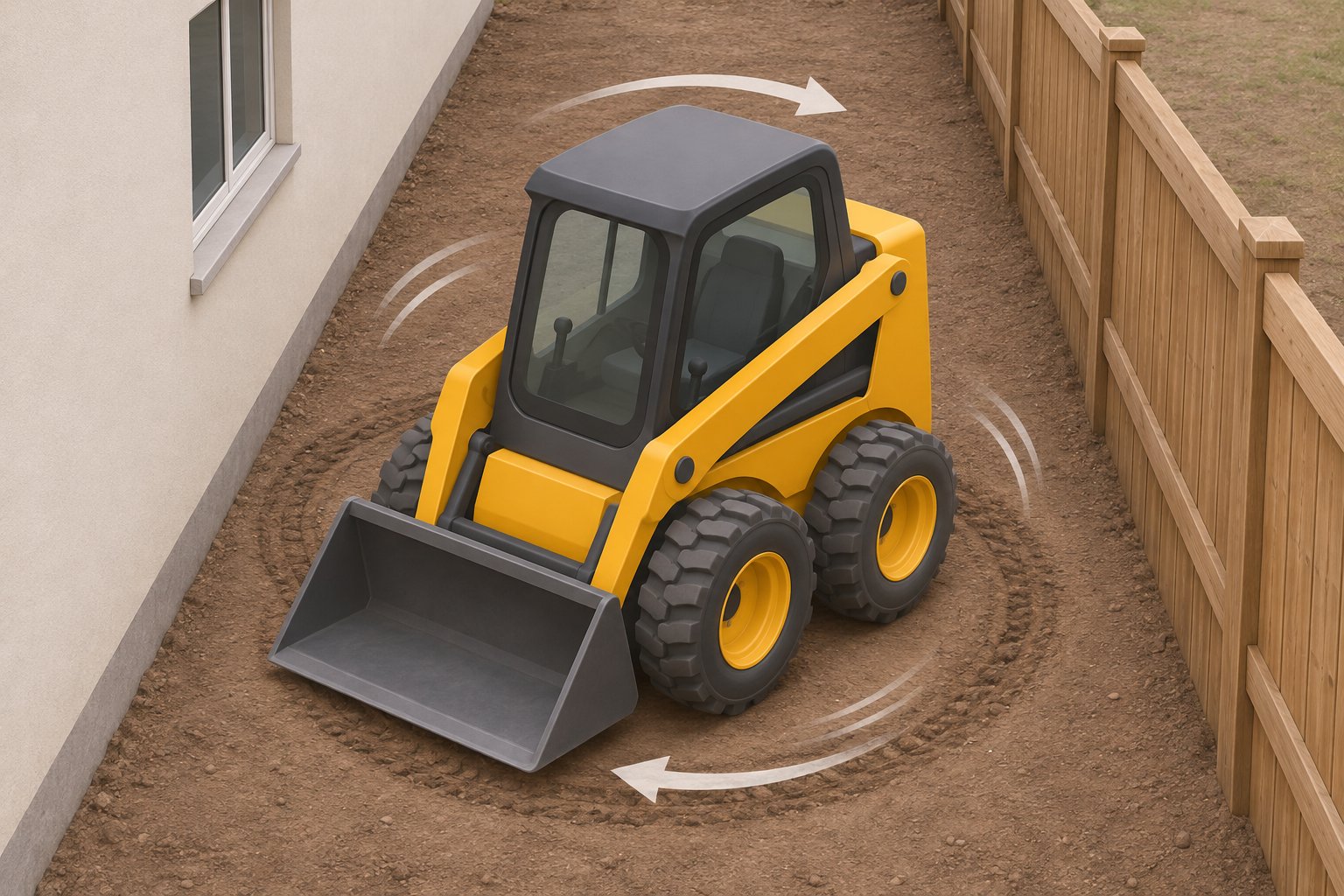
The wheels on the left side are driven together, and so are the wheels on the right. To turn, the machine runs the two sides at different speeds. For the tightest turns, one side drives forward while the other drives in reverse. The wheels can't point in a new direction, so the tires skid sideways across the ground as the machine pivots. The name comes from that skidding.
Imagine working in the narrow strip between a house and a fence. A car would need a wide arc to turn around there. A skid steer can rotate within its own footprint and head back the way it came.
The cost of this design shows up on the tires and the ground. Tires scuff on every tight turn, so tire wear becomes a regular maintenance expense. The skidding can also disturb turf and loose soil and leave marks on soft or finished surfaces, such as a new lawn or decorative pavers.
Skid Loader, Skidloader and Other Names
Skid steer, skid-steer loader, skid loader and skidloader all name the same machine class. "Skid-steer loader" is the full term. The others are shorter versions you'll hear on job sites and see in equipment listings. That's why searchers use several different words for one machine.
Many people use one more name for it: they just call it "a Bobcat." That habit started with a loader built for a turkey farm in Minnesota.
How the Bobcat Name Became Shorthand for Skid Steers
Why do so many people call every small loader "a Bobcat"? The habit goes back to a farm problem in western Minnesota, from before this kind of machine had a common name.
A Turkey Barn Loader From 1957
In 1957, turkey farmer Eddie Velo brought a problem to Cyril and Louis Keller, who repaired machinery for farmers in Rothsay, Minnesota. His two-story turkey barns needed cleaning, but his tractor loader couldn't get around the upright support poles. The only other option was cleaning by hand. Velo needed a self-propelled loader light enough to be lifted to the second floor and agile enough to work around the poles.
Bobcat's company history describes the machine the Kellers built:
- A simple front-end loader with two drive wheels and a small rear caster wheel
- A 6 hp engine with a rope starter
- Separate left and right control levers that steered the machine through a clutch mechanism
- Fork tines made from bars out of the Rothsay jail, the only steel hard enough for the job
You'll notice the separate left and right controls. Running each side on its own is the same basic idea behind skid steering today.
The loader worked well enough that the Kellers built six more and sold them to nearby farmers. In 1958, their uncle, who sold Melroe farm equipment, introduced them to the Melroe brothers of Melroe Manufacturing Company in Gwinner, North Dakota. The Kellers showed the loader at the Minnesota State Fair, where it drew large crowds. Melroe then hired the brothers to design and build its first self-propelled loader. Doosan Bobcat's corporate timeline puts the first production model in 1958 and the first skid-steer loader in 1960.
When the Bobcat Name Arrived
In 1962, Melroe named its skid-steer loader "Bobcat" to suggest toughness, quickness and agility. The machine was one of the first in a new category, and it sold well for decades. Bobcat says it was the first manufacturer to build more than 1,000,000 loaders.
When one product leads a new category, its brand name often becomes the everyday word for the whole category, as Jacuzzi did for hot tubs. As a result, a Bobcat skid steer loader and a loader from another maker can end up with the same nickname. Someone who asks "what's a Bobcat machine?" may mean any compact loader with this shape, whoever built it.
Who Owns Bobcat Today
The company has changed owners several times. Clark Equipment bought it from Melroe in 1969, Ingersoll Rand bought Clark in 1995, and Bobcat became part of the Doosan Group in 2007. Along the way, in 2000, the Melroe company officially took the name Bobcat Company. Bobcat Company's headquarters is in West Fargo, North Dakota.
- 1957: The Keller brothers build a compact loader for Eddie Velo's turkey barns.
- 1962: Melroe names its skid-steer loader "Bobcat."
- 2007: Bobcat Company becomes part of the Doosan Group.
The nickname stuck, but the machine class grew well beyond one company. Today many manufacturers build skid steers under their own names, and none of those machines is a Bobcat.
Not Every Skid Steer Is a Bobcat
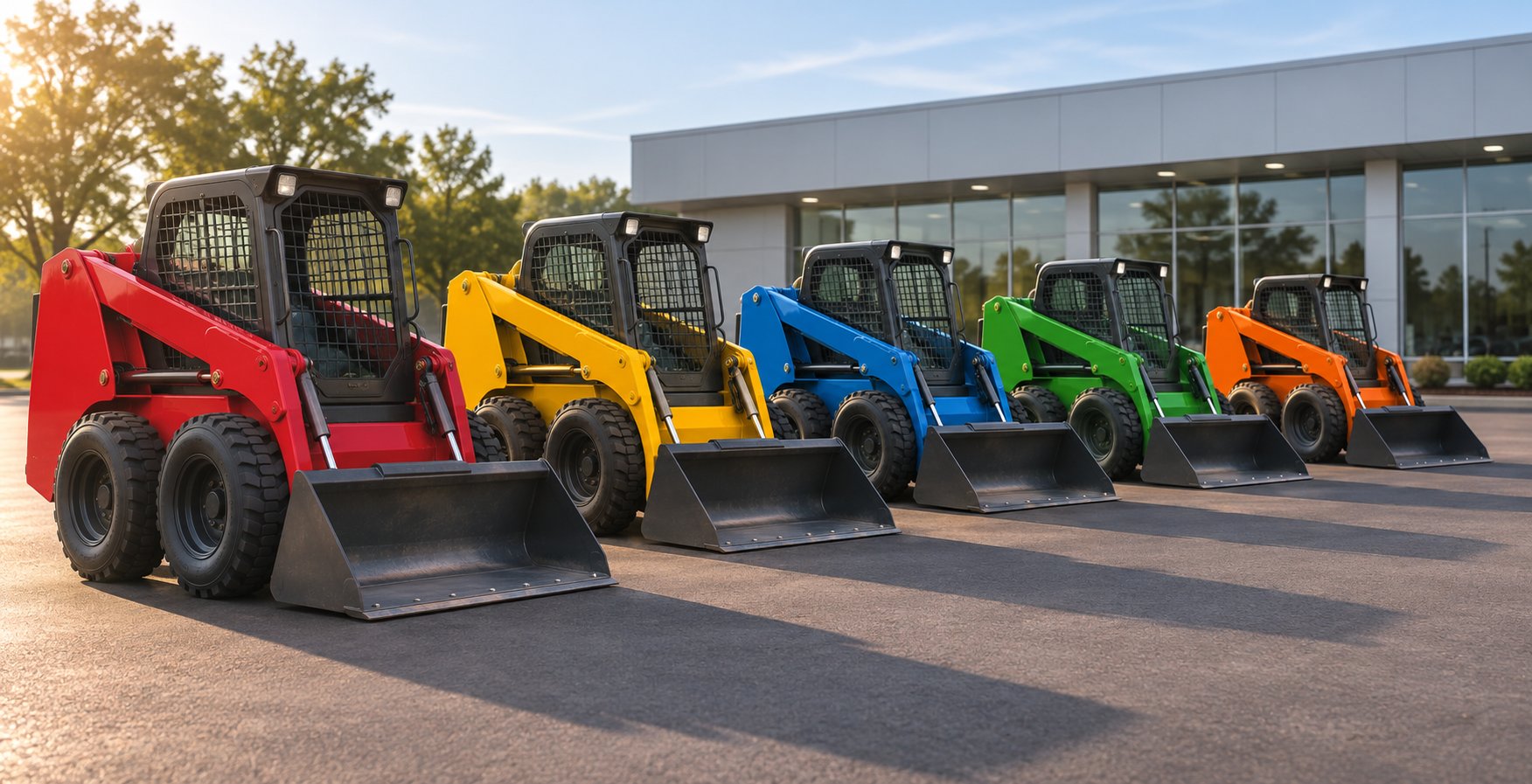
No, not every skid steer is a Bobcat. The Keller brothers' loader started the category, but many companies now build skid steers under their own names. Park a Caterpillar skid steer loader next to a Bobcat and you'll see two machines of the same class with different badges.
Other Companies That Build Skid Steers
Each of these manufacturers sells wheeled skid-steer loaders. The links go to each maker's own skid steer page, where you can see its current models:
This list is not complete. Equipment World's skid steer buyer's guide also covers Hyundai, Kioti, Manitou, SDLG and Sunward, among others.
JCB and the Single-Arm Exception
Most skid steers have two lift arms, one on each side of the cab, and the operator climbs in from the front. JCB builds its skid steers differently. They have a single lift arm, a reinforced U-shaped structure that runs along the right side of the machine. Because there is no arm on the left, the cab gets a side door. The operator can get in and out without stepping over a bucket or forks. JCB explains the layout on its single-arm boom page. These machines are still skid steers. The difference is in the boom and the cab entry.
Comparing Cat, Kubota and Bobcat Skid Steers
People who search "cat vs bobcat skid steer" or "kubota skid steer vs bobcat" are usually trying to choose a machine. Each brand sells several sizes, so a brand-to-brand comparison doesn't tell you much. If you put a small Bobcat next to a large Cat, most of the difference you see comes from size. Compare specific models on these points instead:
- Rated operating capacity: This is the load the machine is rated to lift and carry. Compare it to the heaviest material you expect to handle.
- Horsepower: More power helps with heavy loads, tough conditions and demanding attachments. DOZR's spec guide explains how to read these figures.
- Attachment compatibility: Make sure the coupler and hydraulic flow will run the attachments you own or plan to buy.
- Dealer and parts support nearby: If you can't get the machine serviced quickly, you lose work days.
- Condition of the specific machine: On used equipment, the hours, maintenance records and wear on that machine tell you more than the brand does.
Brand comparisons have one more catch. A listing that just says "Bobcat" may not be a skid steer at all, because Bobcat sells several other kinds of machines.
Bobcat Equipment Types Beyond the Skid Steer
Search a used-equipment site for "Bobcat" and one page of results might show a wheeled loader, a tracked loader, a mower and an excavator. Every one of them is a Bobcat. Only some of them are skid steers. Most of the confusion about the name comes from this overlap.
What Bobcat Equipment Includes
Bobcat's equipment catalog groups its lineup into compact equipment, grounds maintenance equipment, and material handling and industrial solutions. The Bobcat equipment types on its site include:
- Skid-steer loaders
- Compact track loaders
- Mini track loaders
- Compact excavators
- Tractors and mowers
- Material handling and industrial equipment
Only the first category on that list is a skid steer. The others carry the same logo, but each one is a different class of machine.
A Bobcat Excavator Is Not a Skid Steer
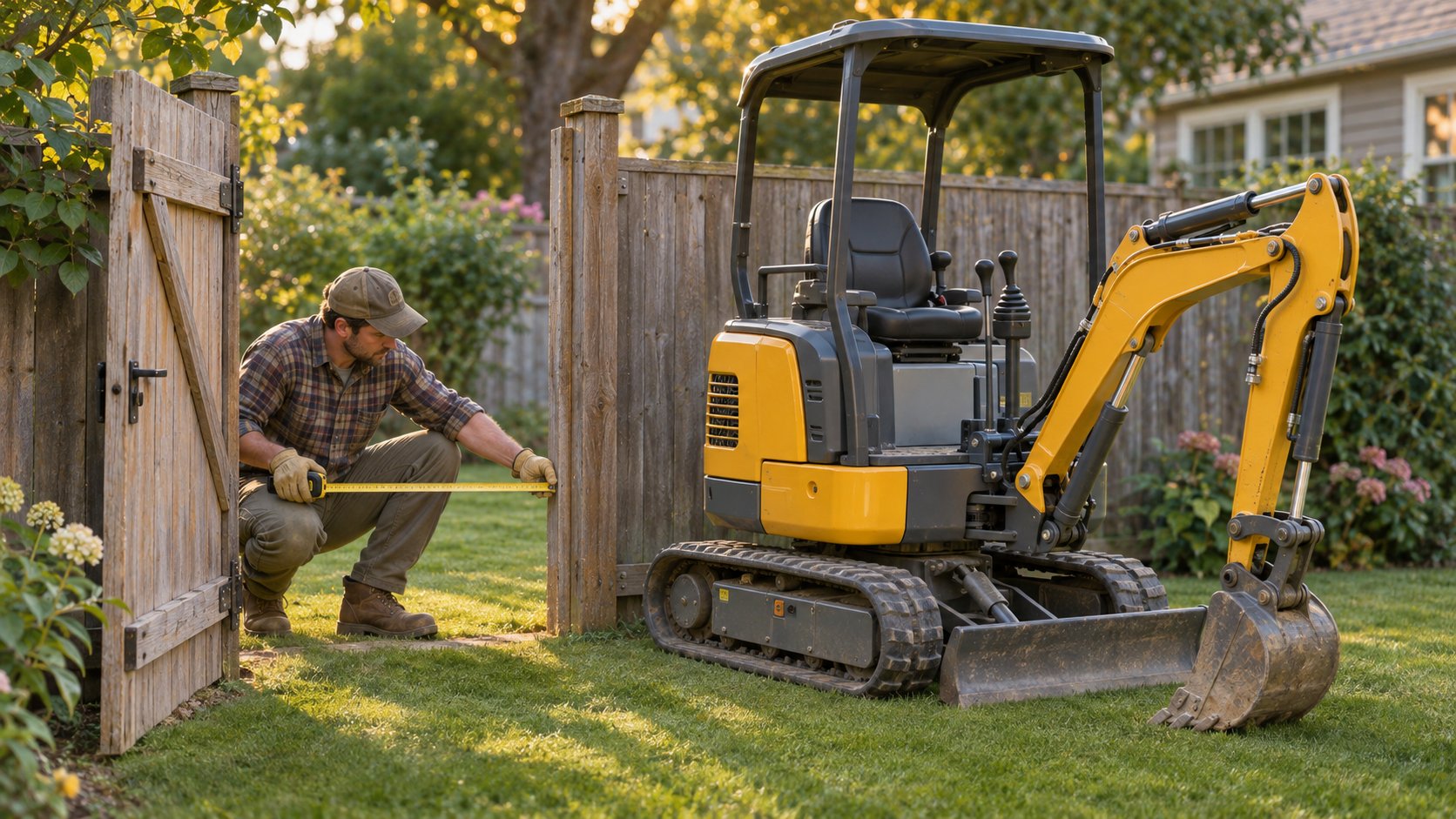
People often call any small Bobcat machine "a Bobcat," and that includes excavators. A Bobcat excavator digs with a boom, and its upper structure rotates. Bobcat says its excavators offer 360 degrees of rotation, so the operator can dig and dump spoil anywhere around the machine. A skid steer has no way to do that. Its lift arms raise and lower a tool at the front, and the whole machine has to turn to face a new direction.
Say a coworker asks you to bring the Bobcat over to dig a trench. Ask which one they mean, because the answer decides what gets loaded on the trailer.
What People Mean by a Mini Skid Steer
"Bobcat mini skid steer" is a popular search. The closest match on Bobcat's site is a category called mini track loaders, which Bobcat lists separately from its skid-steer loaders. The site currently shows two models:
- MT100: less than 36 inches wide, with a ride-on platform for the operator
- MT120: a 1,200-pound rated operating capacity, plus lift height and reach that Bobcat calls best in class
As the category name says, these loaders run on tracks, not wheels. Bobcat treats them as their own category and does not file them under skid steers.
Outside Bobcat's catalog, "mini skid steer" is informal wording. It isn't a defined machine class, so the word "mini" won't tell you a machine's width, capacity or how the operator rides. Check which category the manufacturer lists the machine under, then read the spec sheet for that model.
Tracks come up more than once in Bobcat's lineup. They also explain the most common mix-up: a tracked loader that looks almost exactly like a skid steer but belongs to a different class.
Skid Steer vs Compact Track Loader
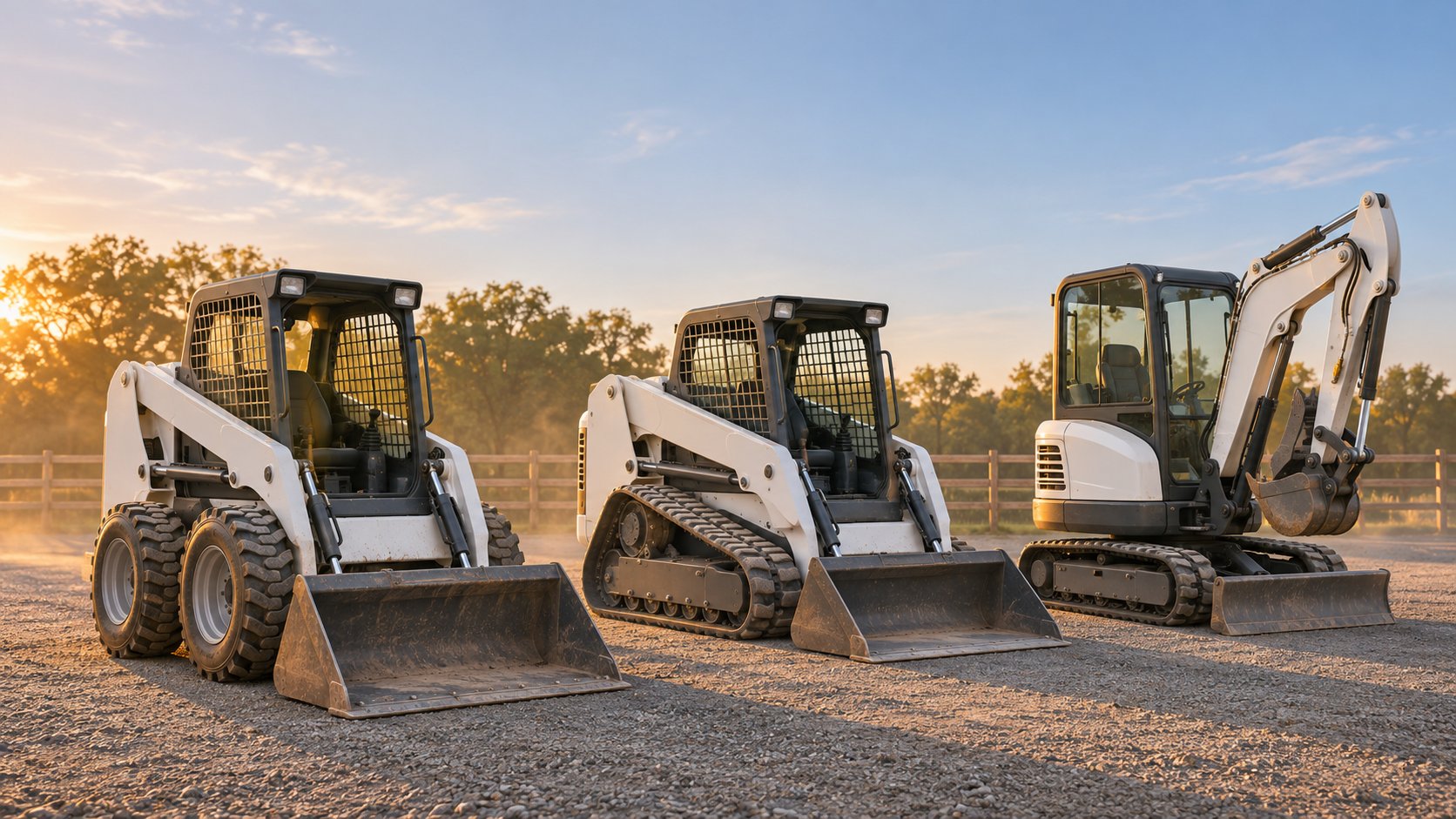
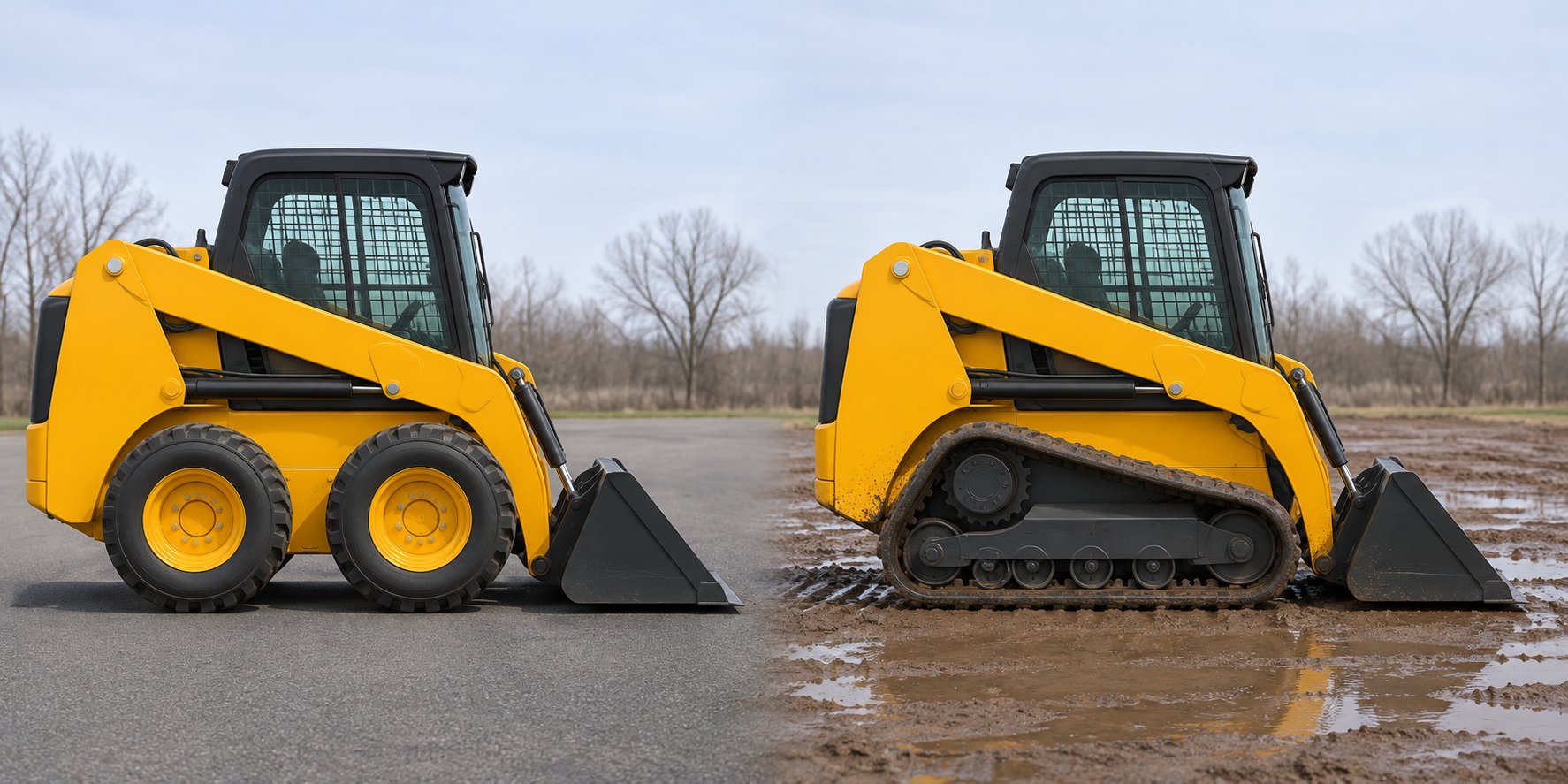
Look at a tracked Bobcat from the side and you'll see the same lift arms, cab and front coupler as a skid steer. The visible difference is underneath the machine. That undercarriage puts it in a different machine class, which is easy to miss when you're browsing Bobcat's loader listings.
Wheels Versus Rubber Tracks
A tracked Bobcat is a compact track loader, often shortened to CTL. It is not a wheeled skid steer. Bobcat's loader buyer's guide says the two machines share a similar body and quick-attach system. The main difference is the undercarriage: skid steers run on wheels, and track loaders run on rubber tracks.
Both machines turn the same basic way. A track loader turns by running its left and right tracks at different speeds, as a skid steer does with its wheels. Because of that shared principle, many people call a track loader a "track skid steer." United Rentals notes that a tracked skid steer is also called a compact track loader or track steer. The nickname works fine on a job site. Manufacturers, though, sell and specify track loaders as a separate class. If you search for a "bobcat track skid steer," the machines you want are listed under Bobcat track loaders.
Reading Bobcat Model Names
Bobcat lists the two classes on separate pages. Its skid-steer loader page shows models such as the Pro S76-2 and the Classic S590. Its compact track loader page shows models such as the Pro T66-2 and the T450.
You might be tempted to guess the class from the first letter of a model name. Don't rely on the letter alone. Before you rent or buy, check which category page lists the model, or read its spec sheet.
When Each Class Fits the Job
Neither machine is better overall. The ground you work on usually decides. Bobcat says skid steers do best on hard, stable ground and in tight spaces, and track loaders do best on soft, rough or slippery ground.
| Factor | Wheeled Skid Steer | Compact Track Loader |
|---|---|---|
| Running gear | Four tires | Two rubber tracks |
| How it steers | Wheels on each side run at different speeds and skid to turn | Tracks on each side run at different speeds to turn |
| Ground it generally suits | Hard surfaces such as concrete, asphalt, gravel and hard-packed dirt | Soft or uneven ground such as mud, sand, snow and slopes |
| Trade-off to watch | Can sink into soft ground, and tires wear out faster | Aggressive tracks can damage asphalt, concrete or grass, and tracks need more cleaning |
| Where it appears on Bobcat's site | Skid-Steer Loaders page | Compact Track Loaders page |
Suppose you're grading a muddy lot in early spring. A track loader spreads its weight over a larger area, so it can keep working where a wheeled machine would sink. If you're clearing a paved parking lot, the wheeled skid steer is usually faster and easier on the surface.
Bobcat's skid-steer page also lists the wheeled lineup's horsepower, lift capacity and starting price. Those numbers show how much one class of machine can vary from its smallest model to its largest.
Bobcat Skid Steer Specs, Weight and Price
How big is a Bobcat skid steer, and what does one cost? That depends on the model. Bobcat's skid-steer loader page sorts its wheeled lineup into size groups. Each group shows a horsepower range, a lift capacity range and a starting price.
Bobcat Skid Steer Horsepower and Lift Capacity
The smallest group covers 23.5 to 68 hp and 760 to 2,300 lb of rated operating capacity. It is only the first group. Bobcat lists two larger groups above it.
| Size Group | Horsepower | Rated Operating Capacity | Starting List Price | Source |
|---|---|---|---|---|
| Smallest (includes the S590) | 23.5 to 68 hp | 760 to 2,300 lb | $29,512 USD | Bobcat |
| Mid-size (includes the S650) | 74 hp | 2,400 to 2,900 lb | $61,101 USD | Bobcat |
| Largest (includes the S770) | 92 to 115 hp | 3,350+ lb | $77,682 USD | Bobcat |
Rated operating capacity (ROC) is the load the machine is rated to lift and carry. The machine's own weight is a separate figure. The S650 shows how far apart the two can be. Bobcat lists it with a 2,690 lb rated operating capacity and a 7,901 lb operating weight. If you plan to haul a loader on a trailer, plan around the operating weight.
How Much a Bobcat Skid Steer Costs
Bobcat skid steer prices start at $29,512 USD. That was the list price for the smallest size group when we checked, and the larger groups start at $61,101 and $77,682. As Paramount Financial's price guide points out, Bobcat's footnote limits these figures to base models. They leave out freight, pre-delivery inspection, taxes, surcharges, options, accessories and attachments, and the local dealer sets the final sale price.
List prices change, so check the page again before you set a budget. Then add what the job needs. A bucket, pallet forks, an auger or an option package each adds a line to the quote. Get written quotes from two dealers and compare them line by line.
Bobcat Skid Steer Models and Weight
Bobcat's skid-steer page currently shows the Pro S76-2 and the Classic S590, S650 and S770. Bobcat's model pages give these figures for three of its machines:
- S70: 760 lb rated operating capacity, $29,512 list price
- S590: 2,000 lb rated operating capacity, $53,934 list price
- S650: 2,690 lb rated operating capacity, $61,101 list price
How much does a Bobcat skid steer weigh? It depends on the model. The S650's 7,901 lb operating weight is the only weight figure in our sources. For any other model, find the operating weight on that model's spec sheet. A size group won't tell you.
These numbers only help if the rental desk, the seller or the parts counter is talking about the same machine you are, and that depends on which words you use when you ask.
Which Term to Use When Renting, Hiring or Buying
When you call a rental desk or post a job ad, which word gets you the right machine or the right person? A simple rule covers most cases. The machine class, skid steer or compact track loader, describes the work. The brand and model matter when something has to match one exact machine, as parts, service and attachments do.
| Situation | Term to Use | When the Brand Matters |
|---|---|---|
| Renting | Skid steer or compact track loader, plus the capacity you need | Only if the job requires a specific model |
| Hiring an operator | Skid steer operator or compact track loader operator | Rarely. Experience with the machine class counts most |
| Writing a job listing | "Skid steer operator," with "Bobcat" also in the text | Include the word so the listing shows up for people who search with it |
| Buying used | Brand, class and model | Always. The brand tells you who built the machine, not what class it is |
| Ordering parts | Brand, model and serial number | Always. Parts are matched to the specific machine |
| Choosing attachments | Your machine's make and model | Always. Confirm the fit with the attachment maker |
| Booking operator training | The machine class you will operate | Less than the class. Check which classes the course covers |
Renting and Hiring
When you rent, ask for the machine class first. Then give the rated operating capacity you need and say whether you want wheels or tracks. A request like "a wheeled skid steer with about 2,000 lb of capacity for a paved lot" gives the rental desk everything it needs. Name Bobcat only if the job requires a specific model.
Job listings need both words. Use "skid steer operator" as the title, and put "Bobcat" in the description too. Many operators call every compact loader a Bobcat, so that is the word they search for. If the job uses track loaders, say that as well.
Buying Used and Ordering Parts
A "Bobcat for sale" listing tells you the brand but not the class. Before you compare prices, confirm whether the machine is a wheeled skid steer or a compact track loader. Then confirm the model, serial number, hours and condition. Westerra Equipment's used skid steer guide says hours are the first thing to check. Its example: a 4-year-old machine with 2,000 hours is typically a better buy than a 2-year-old machine with 3,000 hours of full-time work. The guide also suggests asking for maintenance records, the number of past owners, the kind of work the machine did and whether any attachments come with it.
Suppose you search "bobcat skid steer for sale" and find a good match. When it needs a filter or a hydraulic hose, the brand name alone won't get you the right part. The parts counter needs the brand, model and serial number. Write them down on the day you buy the machine.
Attachments and Operator Training
If you're shopping for Bobcat skid steer loader attachments, ask the attachment maker to confirm that the coupler fits your machine before you buy. A plate that fits is only the first check. Farmry's attachment compatibility guide explains that "universal" usually describes the mounting interface. An attachment can mount correctly and still be wrong for your machine's hydraulic flow and pressure, its capacity or its controls. The guide suggests checking in this order: mount, hydraulics, weight and capacity, controls, and then the job. It also warns that mini skid steer attachments often use different mounting systems than full-size machines.
For training, make sure the course covers the class you'll operate: skid steer, compact track loader or both. For example, Caterpillar's online operator course covers skid steer, multi-terrain and compact track loaders, and one of its units is on steering track machines. The course takes about an hour and teaches the basics. Ask your employer or job site what training they expect.
Every row in that table assumes a compact loader is the right size for the job. When the work turns into loading trucks and moving stockpiles, it may be time to ask whether a skid steer is the right machine at all.
When a Wheel Loader Fits Better Than a Skid Steer
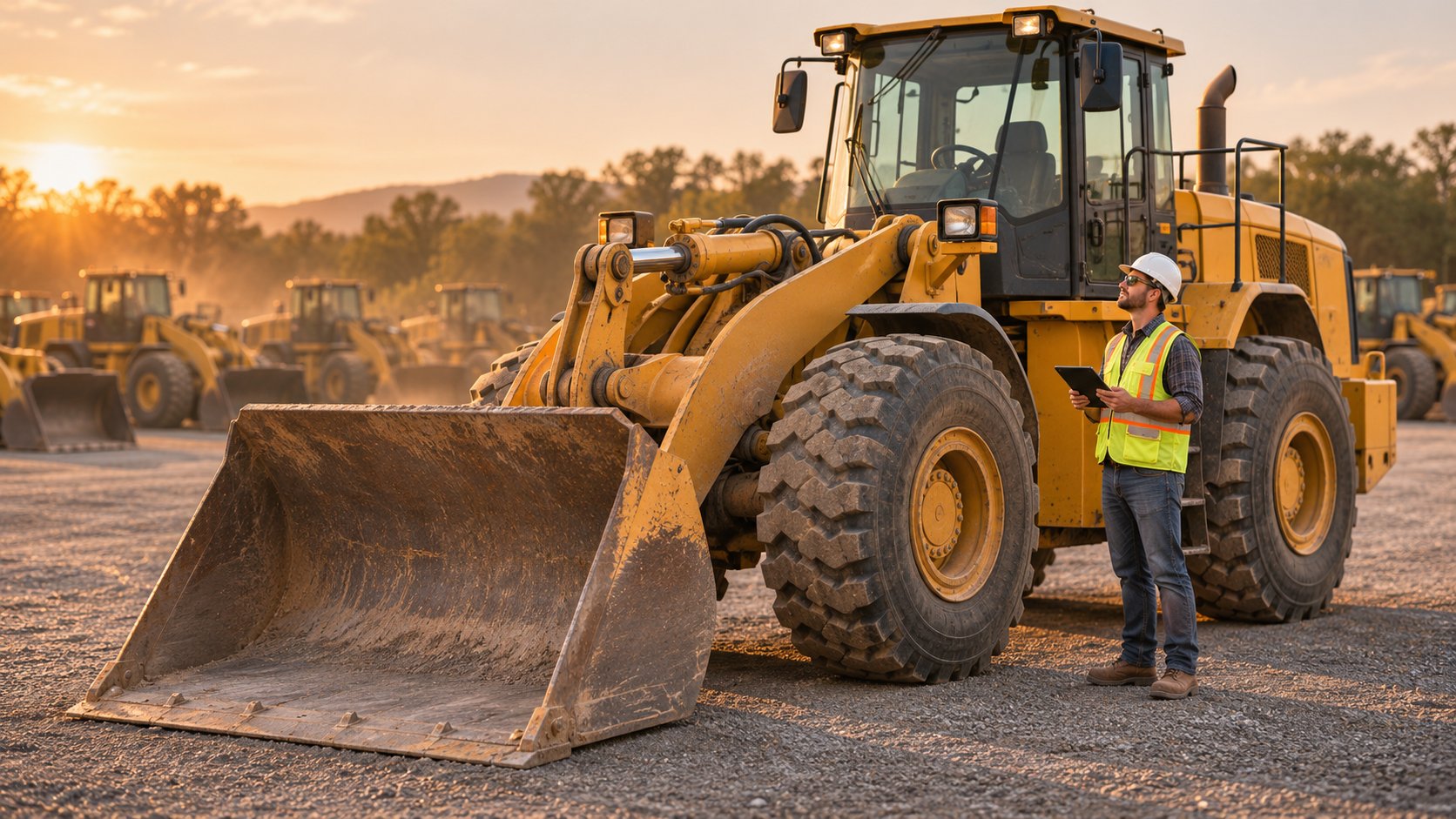
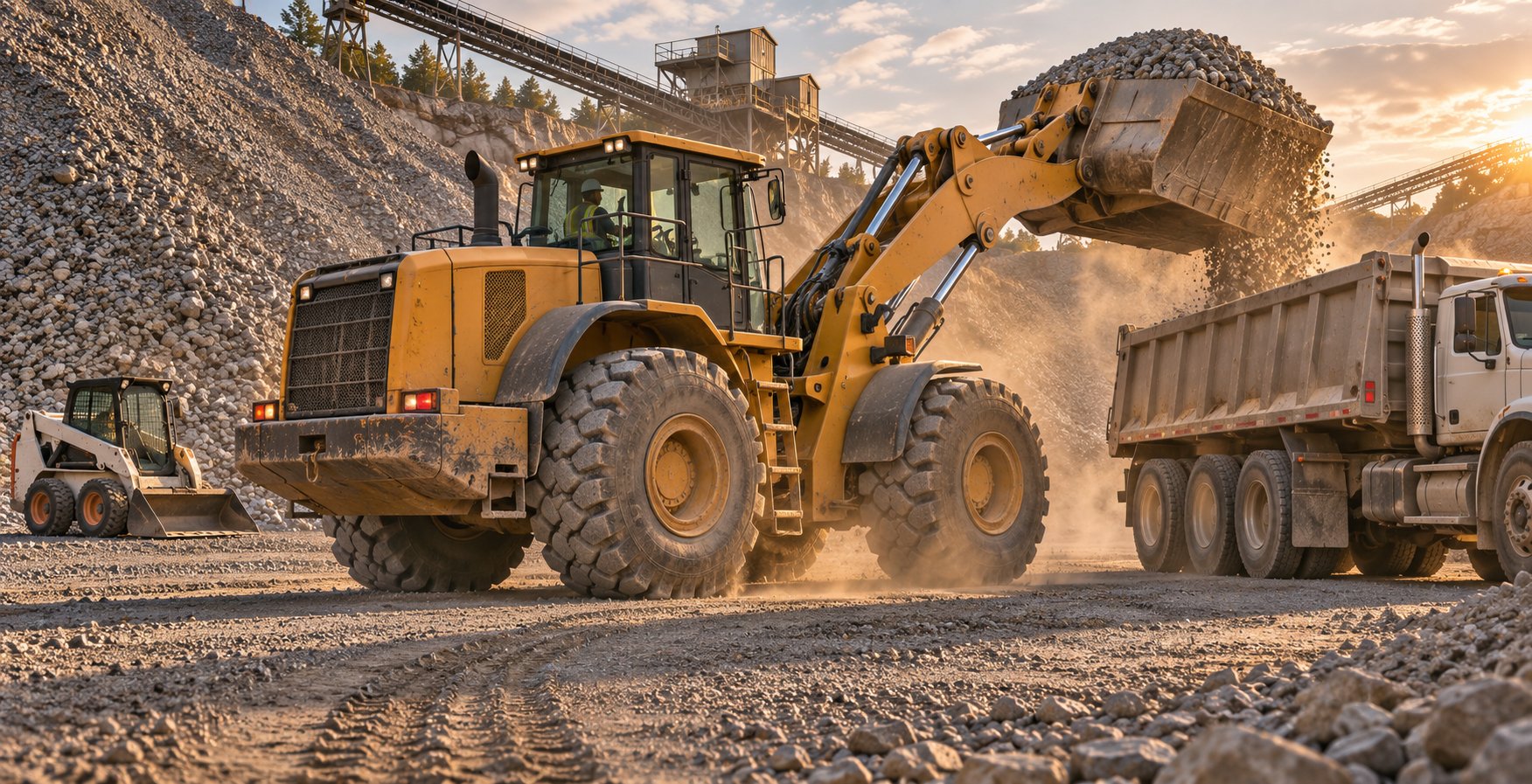
Picture a day spent loading a line of dump trucks from a gravel pile. Even the biggest skid steer on the lot can do that job, but slowly. Work like this usually calls for a wheel loader, and a wheel loader is not a skid steer.
Why a Wheel Loader Is a Different Machine
A wheel loader belongs to its own machine class. It does not turn by skidding its tires the way a skid steer loader does, and its bucket is built to move volume. SANY's loader comparison describes wheel loaders shoveling and hauling bulk material such as sand, gravel, soil and ore, stacking material and clearing sites. A typical job means loading trucks or working a stockpile, with short trips between the pile and the truck.
Buyers also compare wheel loaders on different specs, such as bucket volume, dump height and travel speed. Bobcat's European loader buyer's guide describes its compact wheel loaders as articulating machines with a heavier frame built for bucket volume and faster travel. The same guide notes that they need room to turn and overhead clearance. Steering layouts and sizes differ between makers and models. Check each machine's steering setup and dimensions on its spec sheet, and don't assume them from the category name.
When You Need More Than the Biggest Skid Steer
The largest size group on Bobcat's skid-steer loader page lists 3,350+ lb of rated operating capacity. That number is the top of Bobcat's skid-steer line. It is not a limit for the whole industry. Capacity is only part of the picture. SANY points out that skid steers have limited load capacity and dump height, and their slow travel speed means they move between sites on a trailer. For loading high-sided dump trucks, ReadyDig's decision matrix picks the wheel loader because of its hinge-pin height and forward reach. If most of your work is moving volume, compare wheel loaders alongside the largest skid steers.
| Loader Type | How It Steers | Typical Job Scale | Main Trade-Off | What to Verify Before Buying |
|---|---|---|---|---|
| Wheel loader (not a skid steer) | Does not skid-steer. Steering layout varies by model | Larger-volume work: truck loading, stockpiles, bulk material | Needs turning space, struggles in mud or rough ground, and costs more to buy | Steering configuration, dimensions, bucket size, condition |
| Skid steer | Wheels on each side run at different speeds and skid to turn | Smaller jobs in tight spaces, many attachments | Limited capacity and dump height. Tires wear and can mark soft surfaces | Rated operating capacity, operating weight, coupler and hydraulic fit |
| Compact track loader | Tracks on each side run at different speeds | Similar job scale to a skid steer, on soft or uneven ground | Higher upkeep, and tracks can damage finished surfaces | Rated operating capacity, track and undercarriage wear, attachment fit |
Comparing Used Wheel Loader Options
If a wheel loader fits your work better, buying used can lower the cost. JIUHONG's used loader collection lists wheel loaders such as the Caterpillar 950H and the LiuGong 856H, and you can request a quote for a specific machine. Before you commit, confirm that unit's dimensions, steering configuration, condition and current availability for your job. Don't judge a machine's size or steering from a category label or from the word "mini" in a listing title. The collection is not a source for Bobcat machines or skid steers. If you need a skid steer or compact track loader, find it separately, and confirm its machine class before you trust the brand name on the listing.
Common Questions About Bobcats and Skid Steers
1. Is a Bobcat the same thing as a skid steer?
No. Bobcat is a manufacturer. A skid steer is a type of machine with a rigid frame, fixed wheels and lift arms on both sides of the cab, and it turns by skidding its tires. Bobcat builds skid-steer loaders, but the same badge also goes on compact track loaders, mini track loaders, compact excavators, mowers, tractors and forklifts. When someone asks for 'the Bobcat,' ask which machine they mean. A tracked loader, an excavator and a wheeled loader can all carry the Bobcat name. Only the wheeled loader that steers by skidding is a skid steer.
2. Why do people call skid steers Bobcats?
The habit goes back to the machine's early years. In 1957, Cyril and Louis Keller built a small loader so a Minnesota turkey farmer could clean barns full of upright support poles. Melroe Manufacturing put the design into production and named its skid-steer loader Bobcat in 1962. Bobcat was one of the first machines in a new category and sold well for decades, so its name became everyday shorthand for the whole category, much as Jacuzzi did for hot tubs. Bobcat now belongs to the Doosan Group, and many other companies build skid steers that are not Bobcats.
3. Is a Bobcat track loader a skid steer?
Not by the manufacturer's definition. A tracked Bobcat is a compact track loader (CTL), and Bobcat lists these on a different page from its wheeled skid-steer loaders. The two machines have a similar body, lift arms and quick-attach system. Both turn by running the left and right sides at different speeds, which is why people on job sites often call a CTL a 'track skid steer.' The undercarriage is what separates them. Rubber tracks work better in mud, sand, snow and on slopes, and wheels suit pavement, gravel and hard-packed dirt. Before you rent or buy, check which category page lists the model instead of guessing from the letter in its name.
4. How much does a Bobcat skid steer cost?
When the price was checked, Bobcat's North American skid-steer page listed a starting price of $29,512 USD for its smallest size group. The mid-size group started at $61,101 and the largest at $77,682. These are list prices for base models. They leave out freight, pre-delivery inspection, taxes, surcharges, options and attachments, and the local dealer sets the final price. List prices change, so check the official page again before you set a budget. Add the buckets, forks or augers your work needs, and compare written quotes from more than one dealer. Also plan for hauling. The S650, for example, has a 7,901 lb operating weight, so your trailer and tow vehicle have to handle that weight.
5. Which other companies make skid steers, and how should you compare them?
Caterpillar, John Deere, Case, Kubota, New Holland, Gehl and JCB all build skid-steer loaders. Industry buyer's guides also cover Hyundai, Kioti, Manitou, SDLG and Sunward. JCB's machines have a single lift arm and a side-entry cab, but they are still skid steers. For Cat vs Bobcat or Kubota vs Bobcat, compare individual models of similar size, not whole brands. Look at rated operating capacity and horsepower. Check that the coupler and hydraulic flow suit your attachments, and find out how close the nearest dealer and parts support are. For a used machine, check the hours and maintenance records of that specific unit.